
Spelling Bee Answers: Complete Guide to the NYT Spelling Bee, Pangrams, and Reaching Genius
Spelling Bee answers are the valid words that can be formed from the seven letters displayed in the hexagonal honeycomb grid of the New York Times Spelling Bee puzzle, a daily word game edited by NYT journalist Sam Ezersky where players must find as many words as possible using only those seven letters, always including the center letter, with every word needing to be at least four letters long, and with the ultimate goal of reaching Genius level by earning at least 70 percent of the day’s total possible points.
The NYT Spelling Bee is released daily at 3 AM Eastern Time and has become one of the most popular daily word puzzles in the world alongside Wordle and the daily Crossword.
This complete guide covers every rule of the Spelling Bee, how the scoring system works, what pangrams are and how to find them, all rank levels from Beginner to Queen Bee, expert strategies for reaching Genius every day, and exactly what to do when you are stuck.
What Is the NYT Spelling Bee?
| Detail | Information |
|---|---|
| Created By | New York Times Games |
| Daily Editor | Sam Ezersky, NYT journalist |
| Release Time | 3 AM Eastern Time, every day |
| Format | Hexagonal honeycomb grid of 7 letters |
| Center Letter | Must be used in every word |
| Minimum Word Length | 4 letters |
| Letter Reuse | Allowed, letters can be repeated |
| Pangram Bonus | 7 extra points for using all 7 letters |
| Highest Rank | Queen Bee (find every valid word) |
| Genius Threshold | 70 percent of total possible points |
| Players Reaching Genius Daily | Between 12 and 45 percent of all players |
| Access | NYT website, NYT Games app, New York magazine print edition |
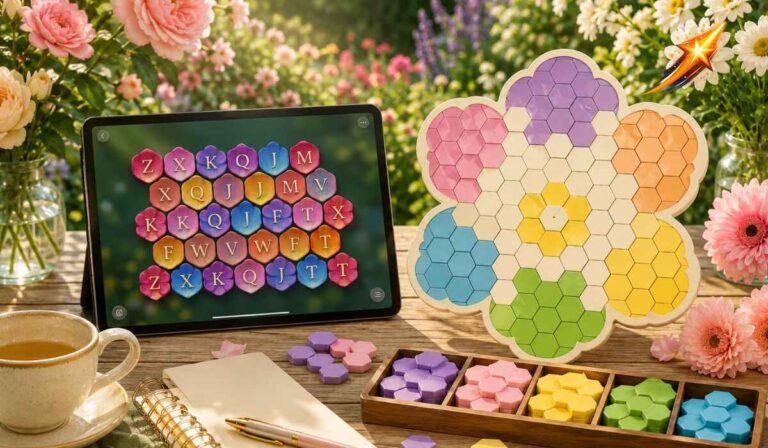
The NYT Spelling Bee is a super familiar yet addictive daily game where players guess as many words as they can from the seven letters on the hexagonal grid. It is edited daily by NYT journalist Sam Ezersky, and the goal is to get to Genius or even Queen Bee status.
Players who prefer to take their puzzles offline can find an alternative Spelling Bee puzzle printed in New York magazine, though the scoring system is slightly different from the digital version.
How the NYT Spelling Bee Works: Rules Explained
The Honeycomb Grid
The game presents seven letters arranged in a honeycomb pattern. One letter sits in the center hexagon. The other six letters surround it in the outer ring. The center letter appears in yellow to distinguish it from the outer letters.
All words you find must contain the center letter. You can use any of the seven letters as many times as you want within a single word. The game does not restrict how many times any single letter appears.
Word Eligibility Rules
For a word to count as a valid Spelling Bee answer, it must meet all four of these conditions:
- Be at least four letters long
- Include the center letter
- Use only the seven letters shown in the hive, with letters reused as needed
- Appear in the game’s accepted word list
Plurals and common verb forms are usually allowed. Proper nouns, acronyms, and hyphenated words are typically rejected. Learning which kinds of words the game accepts will help you score higher over time.
Only the seven letters shown are allowed. Attempting words with other letters will always fail. If a word uses a letter twice but the puzzle shows it only once, that is fine because letters can be reused an unlimited number of times.
Spelling Bee Scoring System
Points are awarded based on word length. Here is the complete scoring breakdown.
| Word Length | Points Awarded |
|---|---|
| 4 letters | 1 point |
| 5 letters | 5 points |
| 6 letters | 6 points |
| 7 letters | 7 points |
| 8 letters | 8 points |
| Each additional letter | 1 additional point |
| Pangram bonus | 7 extra points on top of word length points |
Four-letter words are worth only one point each regardless of the specific letters used. Five-letter words jump to five points, six-letter words earn six points, and the pattern continues with each additional letter adding one more point.
Pangrams earn a significant bonus on top of the word length score. A pangram of exactly seven letters earns 7 points for length plus 7 bonus points, totaling 14 points. A pangram of eight letters earns 8 points for length plus 7 bonus points, totaling 15 points.
For example, if the pangram is CREATING at eight letters, it earns 8 base points plus 7 bonus points for a total of 15 points. This single word equals the combined score of 15 four-letter words in scoring value.
Total Points and Maximum Score
Each puzzle has a certain number of words and a maximum point allocation based on those words. The NYT calculates this total but does not display it directly to players. Your rank is determined by what percentage of the total possible score you have achieved.
All Spelling Bee Ranks Explained
The Spelling Bee rank system tracks your progress as your score grows. Each rank is based on the percentage of total possible points you have earned.
| Rank | Points Required | Percentage of Total |
|---|---|---|
| Beginner | Starting rank | 0 percent |
| Good Start | First milestone | Around 2 percent |
| Moving Up | Building momentum | Around 5 percent |
| Good | Solid progress | Around 8 percent |
| Solid | Above average | Around 15 percent |
| Nice | Well done | Around 25 percent |
| Great | Strong performance | Around 40 percent |
| Amazing | Excellent | Around 50 percent |
| Genius | Daily goal | 70 percent |
| Queen Bee | Perfect score | 100 percent |
Genius is the highest rank you can meaningfully target in daily play. Somewhere between 12 and 45 percent of all players reach Genius each day, making it achievable through strategy and persistence rather than rare talent.
Queen Bee is the highest achievement in the NYT Spelling Bee. You earn the Queen Bee title when you find every single valid word in that day’s puzzle, not just enough to reach Genius level. It requires finding all possible words including every obscure and rarely used word accepted by the game. Queen Bee is rare and requires finding words that most players never consider.
What Is Bingo in Spelling Bee?
Bingo in Spelling Bee is when you manage to find at least one word beginning with each of the seven letters in the provided honeycomb grid. It is a milestone, separate from the rank system, that some players track as a personal achievement during their daily sessions.
What Is a Pangram in Spelling Bee?
A pangram is a Spelling Bee answer that uses each of the seven letters at least once. Every daily puzzle contains at least one pangram, and some puzzles contain more than one.
Identifying a pangram rewards you with seven bonus points in addition to the normal word-length points. Because the pangram must use all seven letters, it is always at least seven letters long, earning at least 14 points in total.
Perfect Pangrams
Some puzzles contain a perfect pangram. A perfect pangram uses all seven letters exactly once, with no letter repeated. Because of this constraint, perfect pangrams are always exactly seven letters long.
A standard pangram allows letter repetition, so an eight-letter pangram that uses one letter twice still qualifies. A perfect pangram does not allow any repetition, meaning all seven letters appear precisely once.
Why Finding the Pangram Matters
Searching for the pangram early in your session gives you a much-needed confidence boost while also opening paths to new related words. Since the pangram gives you bonus points, finding it early gives you a head start on reaching Genius.
If you are aiming for Genius or Queen Bee rank, finding the pangram early is one of the most effective strategies to build score momentum from the start of your session.
How to Find Spelling Bee Answers More Effectively
Strategy 1: Always Start with the Center Letter
Start with the center letter and brainstorm every word you know that features it. Then extend outward by incorporating the surrounding letters. This ensures every word you think of is immediately eligible for the puzzle.
Strategy 2: Hunt the Pangram Early
Dedicate the first few minutes of each session exclusively to hunting the pangram. When searching for a pangram, look for suffixes such as -ing, -ed, -er, -ful, -on, and -est, and prefixes such as re-, un-, pre-, dis-, in-, and im-.
The pangram typically follows common English word-formation patterns, even when the resulting word seems unusual. Looking for standard affixes first dramatically narrows the combinations worth testing.
Strategy 3: Use the Shuffle Button
Shuffle the letters frequently. This forces your brain to see new patterns and reveals combinations you did not notice before. The spatial rearrangement of the same seven letters often triggers word recognition that staring at a fixed arrangement does not produce.
Strategy 4: Work Prefixes and Suffixes Systematically
After finding your initial words, systematically try adding common prefixes and suffixes to every base word you have already discovered. Try combinations such as UN-, RE-, OVER-, ED-, ER-, and ING- to turn one base word into several valid entries.
Look for word families such as sing, singing, and singer. Finding one word in a family often leads immediately to two or three more valid entries.
Strategy 5: Look for Common Letter Pairs
Patterns such as ST, TH, CH, NT, and EX can unlock clusters of related words. When you identify which of these high-frequency letter pairs appear in your current set of seven letters, brainstorm every word you know built on each pair.
Strategy 6: Take Short Breaks
If you hit a wall, step away and come back with fresh eyes. You will often see new possibilities immediately after a break. The NYT Spelling Bee stays open all day with no time limit, so there is no pressure to solve everything in a single sitting.
Split your time across sessions: spend 20 to 25 minutes playing, take a mandatory 10-minute break, then return for a second session. Players who use this multi-session approach consistently reach Genius faster than those who treat it as a one-sitting challenge.
Strategy 7: Accept That Obscure Words Exist
The game’s accepted word list includes many words that are uncommon in everyday speech. If you are consistently a few points short of Genius, some of the missing words are likely short, obscure terms that the game accepts but that most players would never think to try. Experimenting with less common four-letter and five-letter combinations sometimes unlocks unexpected valid answers.
Spelling Bee Answers: What the Game Accepts and Rejects
Understanding the acceptance criteria in detail helps you avoid wasted attempts on ineligible words.
Words the Game Accepts
- Common English words of four or more letters
- Plurals of accepted nouns
- Past tense and progressive forms of accepted verbs
- Words from informal and colloquial usage when included in the game dictionary
- Some words that appear old-fashioned or archaic
Words the Game Rejects
- Proper nouns such as names, cities, countries, and brands
- Hyphenated words
- Abbreviations and acronyms
- Words that require letters outside the seven shown
- Words shorter than four letters even if they would otherwise qualify
One of the most important lessons for improving at Spelling Bee is learning the specific boundaries of what the game’s word list includes. The game’s curated word list was designed to balance difficulty and fun, with every hive including at least one pangram and a mix of shorter and longer words so that beginners and experts alike have something to chase.
Common Spelling Bee Answer Patterns
Certain word patterns, letter combinations, and word families appear frequently across Spelling Bee puzzles regardless of the specific seven letters in use on a given day.
High-Frequency Short Words
Four-letter words earn only one point each but contribute to bingo milestones and help build momentum early in a session. Common four-letter patterns to test immediately include any combination of a consonant plus common vowel pairs like OON, OOT, OOK, and AIR, as well as short but valid words like ANON, NOON, ONTO, and NOON.
High-Value Long Words
Words of eight letters or more are rare but extremely valuable. A single eight-letter word earns eight points compared to one point for a four-letter word. Whenever the seven letters include multiple vowels alongside common consonants like N, T, R, S, and L, check systematically for seven-letter and eight-letter possibilities before settling for shorter plays.
Words That Cycle Repeatedly
The same words cycle through puzzles month after month. The same letter combinations dominate week after week. Once you see the patterns, everything clicks. Words like LLAMA, MAMA, OKRA, and CACAO have appeared repeatedly in Spelling Bee puzzles and catch players off guard with their unusual double-letter structures.
Keeping a personal list of words you missed on previous days builds a reference vocabulary specifically tuned to the patterns the NYT editors favor.
Spelling Bee vs Other NYT Word Games
| Game | Daily Puzzles | Words Required | Time Limit | Sharing | Difficulty |
|---|---|---|---|---|---|
| Spelling Bee | 1 per day | Multiple words | None, all day | Rank only | Medium to hard |
| Wordle | 1 per day | 1 five-letter word | None | Emoji grid | Easy to medium |
| Mini Crossword | 1 per day | Short crossword | Optional timer | Score | Easy |
| Connections | 1 per day | Group 16 words into 4 categories | None | Color grid | Medium |
| Crossword | 1 per day | Full crossword | Optional timer | None | Hard |
| Strands | 1 per day | Find themed words | None | Thread count | Medium |
Spelling Bee is unique among NYT daily word games because it has no time limit and requires finding multiple correct answers rather than one specific target word. This open-ended format, combined with the rank progression system, creates a fundamentally different engagement pattern from Wordle or the Mini Crossword.
How to Use Spelling Bee Answer Guides Strategically
Many players consult daily Spelling Bee answer guides when they are stuck. Using a guide effectively without diminishing the game’s satisfaction requires a thoughtful approach.
Use hints before full answers. Try looking at how many words remain in each length category before seeing the actual words. This gives you a target to work toward without giving away solutions.
Check only the pangram first. Finding the pangram through the guide and then discovering all other words independently is a common approach for players who find the pangram genuinely difficult but want to solve the rest themselves.
Review missed words after finishing. Once you have reached Genius or completed your session, reviewing the words you missed builds vocabulary for future puzzles. The word APHID, TALKATIVE as a pangram, and similar words that have appeared in recent puzzles become part of your Spelling Bee vocabulary for when the same letter combinations appear again.
Track which words surprised you. Keeping a note of words you never would have considered builds a personal database of Spelling Bee vocabulary that improves your performance over time without relying on guides during play.
Tips for Reaching Genius Every Day
Genius requires 70 percent of total possible points. On a typical puzzle, Genius requires capturing roughly 35 to 45 words. The total number of words available per puzzle varies widely, with some days having 50 and others more than 80.
Run the same systematic process every day. Consistency builds pattern recognition. Run all your strategies every day regardless of difficulty. Easy puzzles lead to faster execution, not skipped steps.
Commit to dedicated pangram hunting time. Spend the first eight minutes of each session hunting the pangram exclusively before moving to shorter words. Pure focus during this phase consistently improves pangram discovery rates.
Use the multi-session approach. A mandatory break between sessions is not a shortcut. It is the optimal strategy. Your brain processes language connections during rest periods and returns to the puzzle with fresh pattern recognition.
Do not treat Queen Bee as the daily goal. Queen Bee requires finding every word including obscure entries that even experienced players miss. Setting Genius as your primary target keeps the game enjoyable and achievable. Reaching Queen Bee is a bonus when it happens, not the expected standard.
Frequently Asked Questions About Spelling Bee Answers
What are Spelling Bee answers?
Spelling Bee answers are all valid words that can be formed from the seven letters in that day’s NYT Spelling Bee honeycomb grid. Every word must be at least four letters long, must include the center letter, and must appear in the game’s accepted word list.
How many words are in a typical Spelling Bee puzzle?
The number varies significantly each day. Some puzzles have around 50 valid words while others have more than 80. The NYT calculates the total but does not display it to players. Your rank is based on what percentage of the total possible score you have achieved rather than how many words you have found.
What is a pangram in the Spelling Bee?
A pangram is a Spelling Bee answer that uses all seven letters in the grid at least once. Every puzzle has at least one pangram. Finding a pangram earns seven bonus points on top of the normal word-length score.
What is the difference between Genius and Queen Bee?
Genius requires earning 70 percent of the puzzle’s total possible points. Queen Bee requires finding every single valid word in the puzzle, earning 100 percent of total possible points. Queen Bee is significantly harder because it includes obscure words most players would never try.
What time does the NYT Spelling Bee reset?
A new Spelling Bee puzzle is released every day at 3 AM Eastern Time. The previous day’s puzzle is replaced and the new seven-letter grid becomes active.
Can I repeat letters in Spelling Bee?
Yes. Letters can be reused as many times as you want within a single word. If the grid shows only one instance of a letter, you can still use that letter multiple times in one word.
Are proper nouns allowed in Spelling Bee?
No. Proper nouns including names, cities, countries, and brand names are not accepted regardless of whether they are spelled using the available letters.
How is the total possible score calculated in Spelling Bee?
The total possible score equals the sum of all valid words’ point values including length points and pangram bonuses. The NYT calculates this figure but does not show it to players. Your rank percentage is calculated as your points divided by the total possible multiplied by 100.
What does bingo mean in Spelling Bee?
Bingo in Spelling Bee means finding at least one word that starts with each of the seven letters in the honeycomb grid. It is a personal milestone separate from the rank system.
Who edits the NYT Spelling Bee?
The NYT Spelling Bee is edited daily by Sam Ezersky, a journalist at the New York Times. The letter sets are carefully curated to balance difficulty and fun, ensuring every hive includes at least one pangram and a mix of word lengths.
Read Also: Word Unscrambler: Complete Guide to Unscramble Letters and Find Words Instantly