Blossom Game: Complete Guide to the Flower Word Puzzle, Rules, Scoring, and Tips
The Blossom game is a daily free word puzzle where you form as many valid English words as possible from seven letters arranged in a flower shape, with one letter sitting in the center that must appear in every word you create, each word needing at least four letters, and pangrams earning a seven-point bonus for using all seven letters at once.
Available as a Merriam-Webster online game, a standalone mobile app, and through multiple browser-based implementations with unlimited play modes, the Blossom game has grown into one of the most popular alternatives to the NYT Spelling Bee, attracting word puzzle enthusiasts who appreciate its focus on quality over quantity, its clear scoring system, its bonus letter mechanic, and its daily puzzle format that resets at midnight with a fresh set of seven letters.
This complete guide covers every rule of the Blossom game, exactly how scoring works including the bonus letter system, how pangrams work, the best strategies for reaching the highest ranks, a comparison with the NYT Spelling Bee, and where to play both the daily and unlimited versions.
What Is the Blossom Game?
| Detail | Information |
|---|---|
| Game Type | Daily free word puzzle |
| Developer | Multiple versions: Merriam-Webster, Quynh Dau (app), blossomgame.pro |
| Letter Grid | 7 letters arranged in a flower shape |
| Center Letter | Must appear in every word |
| Minimum Word Length | 4 letters |
| Letter Reuse | Allowed, letters can be used multiple times |
| Pangram Bonus | 7 extra points for using all 7 letters |
| Bonus Letter | Additional points for each use in a word |
| Daily Reset | Midnight Eastern Time |
| Unlimited Mode | Yes, available on multiple platforms |
| Platforms | Browser, iOS app, Android app |
| Cost | Free |
| Invalid Words | Hyphenated words, proper nouns, vulgarities, obscure words |
The Blossom game is a daily word puzzle where you create words from 7 letters arranged in a flower shape. Unlike Wordle’s six-guess pressure or Spelling Bee’s demanding genius requirements, Blossom gives you unlimited attempts and a more forgiving entry point while still rewarding deep vocabulary knowledge.
Merriam-Webster, the oldest dictionary publisher in the US, launched the Blossom word game with its own twist on the flower grid format. It is now one of the most popular alternatives to the NYT Spelling Bee and is enjoyed by many puzzle enthusiasts worldwide.
How the Blossom Game Works
The Flower Grid
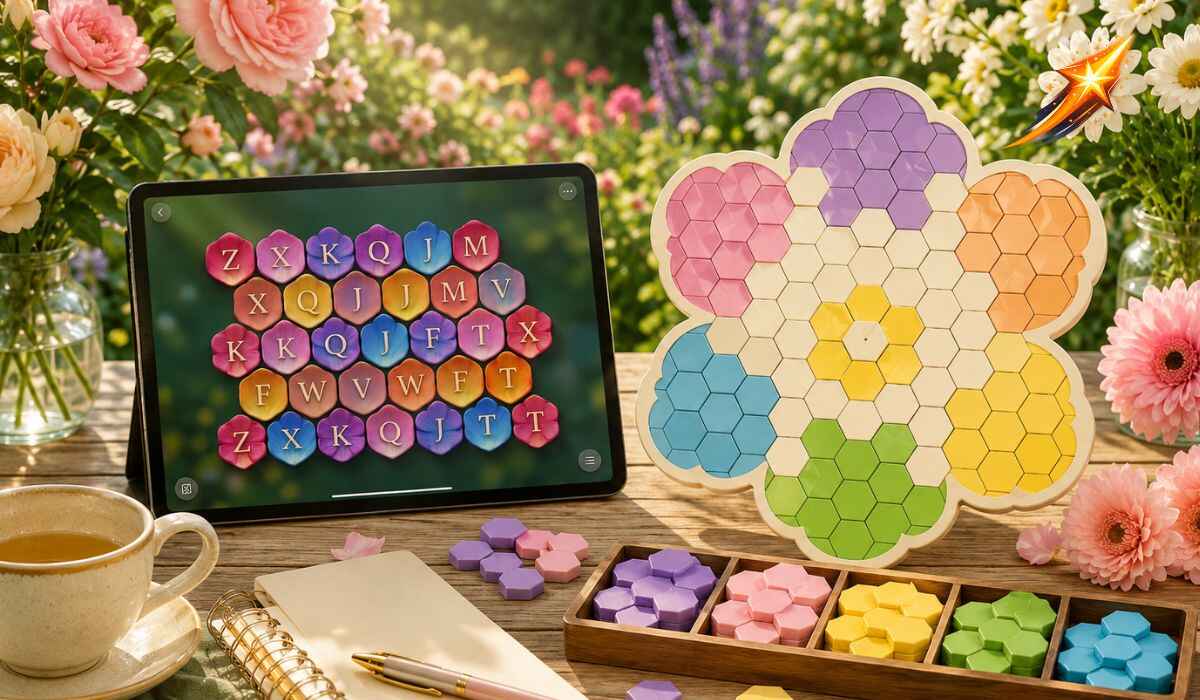
The Blossom game includes a flower-shaped grid with seven letters. Six letters sit one in each petal of the flower. One letter sits in the center. The visual arrangement of the letters on the petals helps players see combinations and patterns that a simple linear list of seven letters would not reveal as clearly.
The Center Letter Rule
Every word you create must contain the center letter. This is the single most important rule in the Blossom game. A word built entirely from the petal letters without the center letter is invalid regardless of how long or complex it is.
Before attempting any word, check whether it can naturally contain the center letter. If the center letter is uncommon like Q or X, the puzzle becomes significantly harder and finding the pangram requires careful thought about which standard English words incorporate that letter.
Word Length Requirements
Every valid word must be at least four letters long. Three-letter words, two-letter words, and single-letter entries are not accepted regardless of whether they include the center letter or are otherwise valid English words.
Letter Reuse
You can reuse letters as often as you like within a single word. If the letter A appears in the grid, you can use it twice or three times in one word. This rule is particularly important for finding pangrams and longer words that repeat specific letters.
Blossom Game Scoring System Explained
The scoring system in the Blossom game rewards longer words significantly more than shorter ones, making it always worth attempting longer combinations even if you are unsure whether they are valid.
| Word Length | Points Earned |
|---|---|
| 4 letters | 1 point |
| 5 letters | 5 points |
| 6 letters | 6 points |
| 7 letters | 7 points |
| 8 letters | 8 points |
| Each additional letter | 1 additional point |
| Pangram bonus | Additional 7 points on top of word length score |
| Bonus letter (each use) | Additional points per use in the word |
Four-letter words are worth only one point each. Five-letter words earn five points. From six letters onward, each word earns one point per letter. This scoring structure makes long words dramatically more valuable than short ones.
Understanding the Bonus Letter
One of the features that sets the Blossom game apart from the NYT Spelling Bee is its bonus letter mechanic. The bonus letter is highlighted separately in the grid. Each time you use this bonus letter in a word, you earn additional points on top of the standard word-length score.
For example, if A is the bonus letter and you create the word ARTERIALLY, a total of 38 points will be awarded: 21 points for entering a 10-letter word, plus 7 for the pangram bonus, plus 10 for using the bonus letter A twice in the word. This single word demonstrates how bonus-letter usage, combined with pangram achievement, can produce extraordinary point totals from a single correct guess.
What Is a Pangram in Blossom?
Pangrams are words that have all seven letters present in the flower grid at least once. Every time you find a pangram, you receive 7 bonus points in addition to the word’s standard length-based score.
There is at least one pangram per puzzle. Some puzzles contain more than one. Finding the pangram is one of the most satisfying moments in any Blossom session and provides the largest single-word point contribution.
Score Benchmarks: How Are You Doing?
| Score Range | Level |
|---|---|
| 150 to 250 | Beginner |
| 300 to 500 | Intermediate |
| 600 plus | Advanced |
These benchmarks give you a practical sense of where you stand relative to other regular Blossom players. Beginner-range scores typically come from finding most four-letter and five-letter words but missing the pangram and most longer combinations. Advanced scores require finding the pangram, most longer words, and strategically exploiting the bonus letter in every qualifying word.
How to Play Blossom Game Step by Step
Step 1: Open the Blossom game in your browser at your preferred platform or download the app on iOS or Android.
Step 2: Study the flower grid. Identify the center letter, the six petal letters, and the highlighted bonus letter.
Step 3: Begin forming words by tapping or typing letters. Every word must include the center letter and be at least four letters long.
Step 4: If the word is valid, it appears in your found words list and your score increases. If invalid, the grid resets without penalty.
Step 5: Continue finding words until you reach the top rank or have exhausted all combinations you can identify.
Step 6: Return tomorrow for a fresh puzzle that resets at midnight Eastern Time.
Blossom Game Rules: What Is and Is Not Accepted
Valid Words
- Any standard English word of four or more letters that includes the center letter
- Words that use petal letters multiple times when those letters repeat naturally in the word
- All tenses and plural forms of accepted words when they appear in the dictionary
- Words from any vocabulary level as long as they appear in the accepted dictionary
Invalid Words
- Hyphenated words regardless of length or center letter inclusion
- Proper nouns including names, cities, countries, and brands
- Vulgarities and offensive language
- Obscure words not recognized by the game’s accepted word list
- Any word under four letters
- Any word that does not contain the center letter
The game uses Merriam-Webster dictionary validation in the official version. The dictionary standard means that many informal, slang, or highly technical words that you might expect to be valid are not accepted, while some surprisingly archaic or unusual words that appear in Merriam-Webster are valid even if unfamiliar.
Daily vs Unlimited Mode
Daily Mode
The official Blossom puzzle releases one game per day at midnight Eastern Time. Everyone who plays the daily mode on the same day has the same seven letters and the same puzzle. This shared-puzzle structure creates the social dimension of comparing scores and discussing strategies with friends who played the same challenge.
Unlimited Mode
Unlimited mode offers randomly generated puzzles so you can play as many rounds as you want with the same rules and scoring. A new challenge appears immediately after you finish one puzzle rather than waiting until midnight.
Unlimited mode is perfect for improving vocabulary, practicing a new strategy, killing time while traveling, or simply enjoying the gameplay loop without restrictions.
The app by Quynh Dau features a new daily blossom game generated at midnight, and you can also play in unlimited mode to practice for free.
Blossom Game vs NYT Spelling Bee
The most common comparison people make is between the Blossom game and the New York Times Spelling Bee. Here is a clear side-by-side breakdown.
| Feature | Blossom Game | NYT Spelling Bee |
|---|---|---|
| Grid Shape | Flower, 7 letters | Honeycomb, 7 letters |
| Center Letter Rule | Yes | Yes |
| Minimum Word Length | 4 letters | 4 letters |
| Bonus Letter System | Yes, highlighted bonus letter | No |
| Pangram Bonus | 7 points | 7 points plus separate calculation |
| Pangrams Per Puzzle | At least one | At least one |
| Daily Reset | Midnight Eastern | Midnight Eastern |
| Unlimited Mode | Yes, free | No free unlimited mode |
| Cost | Free | Free for basic, NYT subscription for full access |
| Official Source | Merriam-Webster, various apps | New York Times |
| Rank System | Score-based benchmarks | Beginner to Queen Bee progression |
| Focus | Quality over quantity | Comprehensive word discovery |
The Blossom game sets itself apart by focusing on quality over quantity. While Spelling Bee rewards finding every possible word including obscure entries, Blossom’s bonus letter system creates specific high-value targets within each puzzle that reward strategic word selection over exhaustive searching.
Another key difference is access. Unlike Spelling Bee which requires a New York Times subscription for unlimited past puzzles, you can play Blossom daily free of cost and also access unlimited mode without any subscription.
Expert Strategies for High Scores in Blossom
Strategy 1: Hunt the Pangram First
We recommend hunting down the Pangrams first. Finding the pangram early gives you the 7-point bonus immediately, boosts your score momentum, and often reveals related words built from the same seven letters.
Pangrams typically follow standard English word formation patterns. Look for suffixes like -ING, -ED, -TION, -NESS, and -FUL, and prefixes like RE, UN, PRE, and DIS when searching for a pangram. These common word-building elements often appear in words long enough to naturally contain all seven letters.
Strategy 2: Exploit the Bonus Letter
Every time you use the bonus letter in a word, you earn additional points. Make it a deliberate strategy to find as many valid words as possible that contain the bonus letter, and look for longer words where the bonus letter appears multiple times to maximize the per-word bonus point accumulation.
Strategy 3: Look for Word Families
Finding one base word often reveals a cluster of related forms. If you find BASE, immediately try BASES, BASED, BASEMENT, and other derivatives. Each valid extension earns length-based points and may incorporate the bonus letter or center letter more frequently.
Strategy 4: Search for Prefixes and Suffixes Systematically
Common prefixes such as RE, UN, PRE, and DIS and common suffixes such as ING, ED, ER, TION, and LY transform base words into additional valid entries. After finding a base word, systematically test whether each common affix creates a new valid entry from the same root.
Strategy 5: Look for Words Within Words
Longer words often contain shorter valid words embedded within them. Spotting these internal words helps you generate multiple entries from the same letter awareness. For example, noticing PLANT within TRANSPLANT helps you find both words from the same letter pattern recognition.
Strategy 6: Start with the Center Letter
Since every word must contain the center letter, brainstorm every word you know that features that letter prominently. Words where the center letter falls naturally in the middle or beginning are easiest to spot under time pressure. Starting with the center letter removes the mental step of constantly checking whether your candidate word includes it.
Strategy 7: Use Hints Strategically
If you get stuck, use the hint system. Save hints for moments when you have found most available words but need one more to reach your target score. Using hints immediately removes the learning benefit of working through difficult combinations yourself.
Blossom Word Search: The Alternative Version
Separate from the seven-letter flower grid puzzle, there is also a version called Blossom Word Search developed by Vento Games, available on Google Play. This is a different game despite sharing the Blossom name.
Blossom Word Search features a different mechanic where you connect letters to form words and reveal hidden answers on the board. It has thousands of levels, a flower collection system where you discover a new flower at every level, and a progressive difficulty system.
The Blossom Word Search version describes itself as perfect for anyone who wants a calm, enjoyable experience, whether you are looking to give your brain a gentle workout or simply escape the stress of daily life.
When searching for the Blossom game, be aware that results may include either the seven-letter flower grid puzzle or the Blossom Word Search connection game. Both are word-based puzzle games but with different mechanics and formats.
How to Improve at the Blossom Game Over Time
Play every day. Daily play builds familiarity with the types of words the Blossom dictionary accepts, which is the most common source of missing valid words.
Review words you miss. After each session, note which words you missed that you could have found. Reviewing these builds awareness of word patterns that appear regularly in future puzzles.
Read Merriam-Webster regularly. Since the official Blossom game uses Merriam-Webster validation, familiarity with Merriam-Webster’s accepted word list directly improves your score. Words that appear in Merriam-Webster but feel unusual are among the most valuable targets in any puzzle.
Practice with unlimited mode. Playing unlimited mode builds the same pattern recognition skills as the daily puzzle without the one-game-per-day restriction. Unlimited sessions that target specific weaknesses such as bonus letter words or pangram hunting improve those specific skills faster than daily play alone.
Set score targets. Rather than playing without a goal, target a specific benchmark in each session. Moving from beginner-range scores to intermediate requires finding consistently longer words and at least one pangram per session.
Where to Play the Blossom Game
Official Merriam-Webster version: Play directly on the Merriam-Webster Games website for the authoritative daily puzzle with full Merriam-Webster dictionary validation.
Mobile app by Quynh Dau: Available on iOS through the App Store. Features a daily puzzle and unlimited mode. Developed specifically for mobile play with touch-optimized controls.
Blossom Word Search by Vento Games: Available on Google Play. A different mechanic featuring word connection and a flower collection system across thousands of levels.
Browser-based unlimited versions: Multiple websites host unlimited Blossom-format puzzles following the same rules and scoring. These are useful for extended practice sessions beyond the one daily puzzle.
Frequently Asked Questions About the Blossom Game
What is the Blossom game?
The Blossom game is a daily free word puzzle where you form valid English words from seven letters arranged in a flower shape. Every word must contain the center letter and be at least four letters long. Pangrams using all seven letters earn a bonus.
How is the Blossom game different from NYT Spelling Bee?
Both games use seven letters in a flower or honeycomb arrangement with a mandatory center letter. Blossom adds a bonus letter mechanic that awards extra points for each use. Blossom is also available free with unlimited mode while Spelling Bee’s full access requires an NYT subscription.
What is a pangram in the Blossom game?
A pangram is a word that uses all seven letters in the alphabet at least once. Finding a pangram earns 7 bonus points on top of the word’s standard length-based score. Every puzzle contains at least one pangram.
What is the bonus letter in Blossom?
The bonus letter is a highlighted letter in the flower grid. Each time you use this letter in a word, you earn additional points beyond the standard word-length score. Words that use the bonus letter multiple times accumulate significantly higher totals.
How do you score points in the Blossom game?
Four-letter words earn 1 point. Five-letter words earn 5 points. Six-letter words and longer earn 1 point per letter. Pangrams earn an additional 7-point bonus. The bonus letter adds extra points for each appearance in a word.
Is the Blossom game free?
Yes. Both the official daily version and unlimited mode on most platforms are completely free with no subscription required.
Can I play Blossom on mobile?
Yes. The Blossom word game works on any device with a browser and no app download is required. A dedicated iOS app is also available through the App Store.
When does the daily Blossom puzzle reset?
A new puzzle drops every day at 12:00 AM Eastern Time. The official daily challenge stays available until midnight, replaces it with the next puzzle.
What words are not accepted in Blossom?
Hyphenated words, proper nouns, vulgarities, and obscure words not in the accepted dictionary are all invalid. Words under four letters are also not accepted regardless of other conditions.
What is a good score in Blossom?
Scores of 150 to 250 are beginner level. Scores of 300 to 500 are intermediate. Scores of 600 and above are advanced and indicate consistent discovery of long words, pangrams, and bonus letter words.
Read Also: Blooket Dashboard: Complete Guide for Teachers, Students, and Parents