
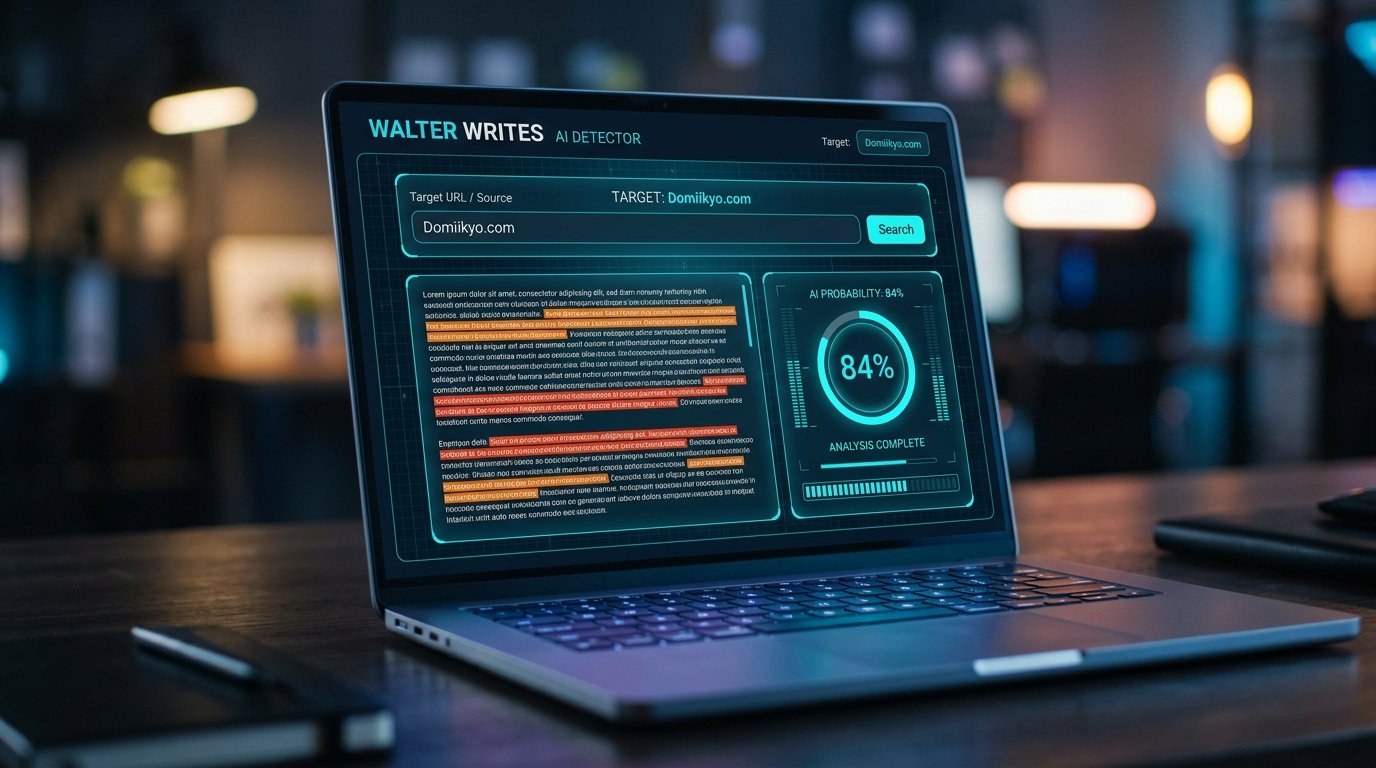
Walter Writes AI Detector Review: Is It Accurate?
Introduction
If you searched for “walter write ai detector,” you are probably looking for the Walter Writes AI Detector and want to know what it does, how it works, whether it is free, and how reliable its results are.
Walter Writes AI Detector is an AI-content detection tool designed to estimate whether text appears to have been generated by artificial intelligence. It can analyze writing and provide an AI probability score, while also helping users identify sections that may appear AI-generated.
But an important question remains: Can you trust an AI detector score as proof that a person used AI?
The short answer is no single AI detector should be treated as absolute proof of authorship. Detection results are estimates and can vary depending on the text, writing style, AI model, editing, and other factors.
This guide explains how Walter Writes AI Detector works, what its score means, its features and limitations, and how it compares with other AI detection tools.
What Is Walter Writes AI Detector?
Walter Writes AI Detector is an AI-content detection tool from Walter Writes. It is designed to analyze submitted text and estimate whether the writing resembles AI-generated content.
The tool is aimed at people who want to check text for possible AI involvement, including students, educators, researchers, writers, publishers, and professionals.
Walter Writes says its detector can analyze content associated with popular AI systems such as ChatGPT, Claude, and Gemini.
The detector focuses on patterns in writing rather than simply searching for copied phrases. Depending on the analysis, users can receive an overall AI score and information about potentially AI-generated sections.
How Does Walter Writes AI Detector Work?
AI detectors generally examine characteristics of text that may differ between human and machine-generated writing.
Walter Writes describes signals including linguistic patterns, sentence structure, semantic flow, perplexity, and burstiness as part of its detection approach.
AI Probability Scoring
The detector provides an indication of how likely the analyzed content is to resemble AI-generated writing.
A higher AI probability does not automatically mean that the text was definitely written by AI. Instead, it should be interpreted as an estimate produced by the detection system.
Sentence-Level Analysis
Walter Writes also provides analysis at a more detailed level, allowing users to identify portions of content that may have contributed to the overall detection result.
This can be useful when reviewing a long document because an overall score alone may not explain which sections triggered the detector.
Linguistic Patterns
AI-generated writing can sometimes contain recurring structural and linguistic characteristics.
An AI detector attempts to identify those patterns and compare them with characteristics commonly associated with human or machine-generated text.
However, writing styles overlap. Human writers can produce highly predictable or formal text, while AI-generated text can be edited to appear more natural.
Is Walter Writes AI Detector Accurate?
Walter Writes AI Detector can be useful as an AI-writing screening tool, but its results should not be treated as definitive proof of authorship.
This is one of the most important points to understand when using any AI detector.
Walter Writes itself explains that AI detection is not completely certain. Independent reviews and tests of AI detectors have also shown that results can vary depending on the type and condition of the text being tested.
For example, detector performance may change when text is:
- Completely AI-generated
- Human-written
- Edited by a human
- Paraphrased
- Rewritten
- A mixture of human and AI writing
- Very short
- Highly formal or academic
Therefore, an AI score should be treated as one signal, rather than final evidence.
What Does a Walter Writes AI Score Mean?
An AI detector score represents the system’s estimate about whether the submitted text resembles AI-generated writing.
It does not necessarily answer:
“Who wrote this text?”
Instead, it answers something closer to:
“How strongly does this text resemble patterns associated with AI-generated writing?”
This distinction is extremely important.
For example, a human-written document could potentially receive an AI indication because its language is highly structured or predictable.
Likewise, AI-generated text that has been extensively edited may become more difficult for a detector to identify.
AI Score vs Proof of Authorship
| AI Detector Result | What It Can Suggest | What It Cannot Prove |
|---|---|---|
| High AI probability | Text resembles AI writing | Who actually wrote it |
| Low AI probability | Text resembles human writing | That AI was never involved |
| Flagged sentences | Certain passages triggered detection | That those passages were definitely AI-written |
| Different detector scores | Detection systems disagree | Which system is automatically correct |
This is why important decisions should not be based on one detector score alone.
Is Walter Writes AI Detector Free?
Walter Writes provides access to its AI detection functionality, including a free AI detector experience.
However, features, limits, account requirements, and paid options can change over time.
If you are evaluating the tool, check the current Walter Writes pricing and product information before relying on a specific word limit or plan feature.
For an evergreen article, it is better to avoid claiming a permanent word limit unless that limit has been verified recently.
How to Use Walter Writes AI Detector
Using an AI detector generally involves a simple process.
Step 1: Open the AI Detector
Visit the Walter Writes AI Detector page.
Step 2: Add Your Text
Paste the writing you want to analyze or use the available upload functionality when supported.
Step 3: Start the Detection
Run the AI detection analysis.
Step 4: Review the AI Score
Look at the overall result and understand what the score represents.
Step 5: Examine Flagged Sections
If the tool identifies specific sentences or sections, review those areas rather than focusing only on the overall percentage.
Step 6: Consider Additional Evidence
If the result matters for academic, professional, or publishing purposes, consider other evidence such as drafts, revision history, citations, and the writer’s documented workflow.
Can Walter Writes Detect ChatGPT?
Walter Writes markets its AI detector as being capable of analyzing content associated with ChatGPT and other popular AI systems.
However, no responsible AI detector should be assumed to identify every ChatGPT-generated passage perfectly.
ChatGPT output can be:
- edited
- paraphrased
- shortened
- expanded
- combined with human writing
- rewritten into a different style
These changes can affect detection results.
Can Walter Writes Detect Claude?
Walter Writes also identifies Claude among the AI systems its detector can analyze.
As with ChatGPT, detection should be understood as an estimation process rather than a guaranteed identification system.
Claude-generated content can also be modified before detection, which can influence the final result.
Can Walter Writes Detect Gemini?
Walter Writes also lists Gemini among the AI systems associated with its AI detection capabilities.
The same basic limitation applies: a detector cannot be expected to provide perfect identification for every piece of generated or edited text.
Walter Writes AI Detector vs Plagiarism Checker
An AI detector and plagiarism checker perform different jobs.
AI Detector
An AI detector estimates whether writing resembles AI-generated content.
Plagiarism Checker
A plagiarism checker looks for matching or substantially similar material from existing sources.
Therefore:
AI detection ≠ plagiarism detection.
A document can be:
- original but AI-generated,
- human-written but contain copied material,
- AI-generated and plagiarized,
- human-written and original.
These are different questions and require different forms of analysis.
Walter Writes AI Detector vs GPTZero
Walter Writes and GPTZero are both associated with AI-content detection, but their scoring systems, models, interfaces, and detection methodologies can differ.
This means two detectors can sometimes produce different results for the same passage.
Instead of asking which detector is always correct, a better question is:
What evidence supports the conclusion?
For important decisions, compare detector results with writing history, drafts, citations, and other relevant evidence.
Walter Writes AI Detector vs Turnitin
Turnitin is widely associated with academic integrity and plagiarism-related workflows, while Walter Writes provides AI detection and other writing-related tools.
They should not automatically be treated as identical products.
If you are a student or educator, check your institution’s specific policies before interpreting any AI detection result.
Walter Writes AI Detector vs Originality.ai
Originality.ai is another AI-content detection platform.
Both tools operate in the broader AI detection market, but their methods and scoring systems can differ.
A difference between two detector results does not necessarily mean one system is intentionally wrong. AI detection is probabilistic, and different systems can evaluate the same linguistic characteristics differently.
What Are the Limitations of Walter Writes AI Detector?
Understanding limitations is just as important as understanding features.
False Positives
A false positive occurs when human-written text is incorrectly identified as AI-generated.
This can be particularly important with formal, academic, technical, or highly structured writing.
False Negatives
A false negative occurs when AI-generated content is classified as human-like.
Editing and rewriting can potentially make AI-generated text harder to detect.
Edited AI Writing
AI-generated content that has been substantially edited may produce a different detection result from the original output.
Human and AI Mixed Writing
Modern content creation can involve both humans and AI.
For example, a writer might:
- Create an outline manually.
- Ask AI for ideas.
- Rewrite the draft.
- Add personal experience.
- Edit the final version.
Determining authorship from the final text alone can therefore be complicated.
Short Text
Short passages may provide less linguistic information for a detector to analyze than longer documents.
Different Detectors Can Disagree
Multiple AI detectors may not produce the same score.
That is why a single percentage should not be treated as an absolute verdict.
What Should You Do If Walter Writes Flags Your Writing?
If you wrote the content yourself and Walter Writes produces an AI indication, do not immediately assume that the detector has proven anything.
Instead:
- Review the highlighted sections.
- Check your drafts and revision history.
- Review your sources and citations.
- Look for unusually repetitive or formulaic language.
- Compare results carefully if another detector is being used.
- Explain your writing process if necessary.
- Follow the relevant academic or professional policy.
For students, maintaining drafts and version history can be particularly useful because these records provide evidence of how a document was created.
Can an AI Detector Prove Who Wrote a Text?
No. An AI detector score by itself cannot conclusively prove authorship.
A detector analyzes characteristics of the submitted text. It does not directly observe the person who created it.
For high-stakes decisions, authorship should be evaluated using multiple forms of evidence.
This distinction is especially important in education, employment, publishing, and other situations where an incorrect accusation could have serious consequences.
How to Get More Useful Results From an AI Detector
If you want to use Walter Writes or another AI detector responsibly, consider the following approach.
Use Enough Context
Where possible, analyze a meaningful amount of text rather than relying on a tiny sentence.
Review Specific Sections
Look beyond the overall score and examine the portions identified by the detector.
Keep Your Drafts
Save outlines, drafts, notes, and revision history.
Compare Carefully
If you use multiple AI detectors, treat differences as information rather than automatically assuming that the highest score is correct.
Do Not Chase a “Human” Score
Trying to manipulate text simply to obtain a lower detector score can reduce clarity and quality.
The goal should be producing useful, authentic writing—not achieving a particular detector percentage.
Who Should Use Walter Writes AI Detector?
Walter Writes may be useful for several groups.
Students
Students can use an AI detector as a preliminary way to review their writing, while following their school’s or university’s AI policy.
Teachers and Educators
Educators can use detection tools as one potential signal when reviewing suspicious content, but should avoid treating a detector score as conclusive evidence.
Writers
Writers may use an AI checker to understand how their content is being classified by automated detection systems.
Publishers and Content Teams
Content teams can use AI detection as one part of a broader editorial quality-control process.
Is Walter Writes AI Detector Worth Using?
Walter Writes AI Detector can be useful if you want a quick way to analyze whether text resembles AI-generated writing.
Its biggest benefit is convenience: users can submit text and receive an AI-oriented analysis without manually evaluating every linguistic characteristic.
Its biggest limitation is the same limitation faced by AI detectors generally:
a detection score is an estimate, not definitive proof of authorship.
If the result is important, combine the detector with contextual evidence and human judgment.
Final Verdict
Walter Writes AI Detector is best viewed as an AI-writing screening tool rather than an absolute authorship test.
It can help users investigate whether text resembles AI-generated content and review potentially suspicious sections. Its support for popular AI systems and detailed analysis can make it useful for writers, students, educators, and content teams.
However, AI detection has important limitations. Human writing can sometimes look AI-like, while edited AI content can become harder to identify. Different detectors may also produce different results.
If you are evaluating a Walter Writes result, focus on the overall evidence, not just one percentage.
For the most reliable assessment, combine AI detection with drafts, revision history, source analysis, writing context, and human judgment.
Bottom line: Walter Writes AI Detector can be a useful signal, but it should not be treated as definitive proof of AI authorship.
FAQs
1. What is Walter Writes AI Detector?
Walter Writes AI Detector is a tool designed to estimate whether submitted text resembles AI-generated writing. It provides AI-related analysis and can identify portions of text that may contribute to the detection result.
2. Is Walter Writes AI Detector accurate?
Walter Writes can be useful for AI-content screening, but its results should not be treated as 100% certain. AI detection can produce false positives and false negatives.
3. Is Walter Writes AI Detector free?
Walter Writes offers access to its AI detector, including a free option. Features and usage limits can change, so users should check the current official offering.
4. How does Walter Writes AI Detector work?
It analyzes characteristics of text associated with AI-generated writing, including linguistic and structural patterns, and produces an AI-related probability or detection result.
5. Can Walter Writes detect ChatGPT?
Walter Writes says its AI detector can analyze content associated with ChatGPT. However, detection is not guaranteed to identify every AI-generated passage.
6. Can Walter Writes detect Claude?
Walter Writes lists Claude among the AI systems its detector can analyze, but results can vary depending on the text and how it has been edited.
7. Can Walter Writes detect Gemini?
Walter Writes also identifies Gemini among the AI systems its detector can analyze. As with other AI-generated text, detection results are estimates rather than absolute proof.
8. Can Walter Writes falsely flag human writing?
Yes. Like other AI detection systems, an AI detector can potentially produce false positives, meaning human-written content may be identified as AI-like.
9. Does Walter Writes check plagiarism?
AI detection and plagiarism checking are different functions. An AI detector estimates whether writing resembles AI-generated content, while plagiarism checking looks for similarities with existing sources.
10. Can an AI detector prove who wrote a text?
No. An AI detector can estimate a text’s characteristics, but a score alone cannot conclusively establish who authored it.



One Comment