
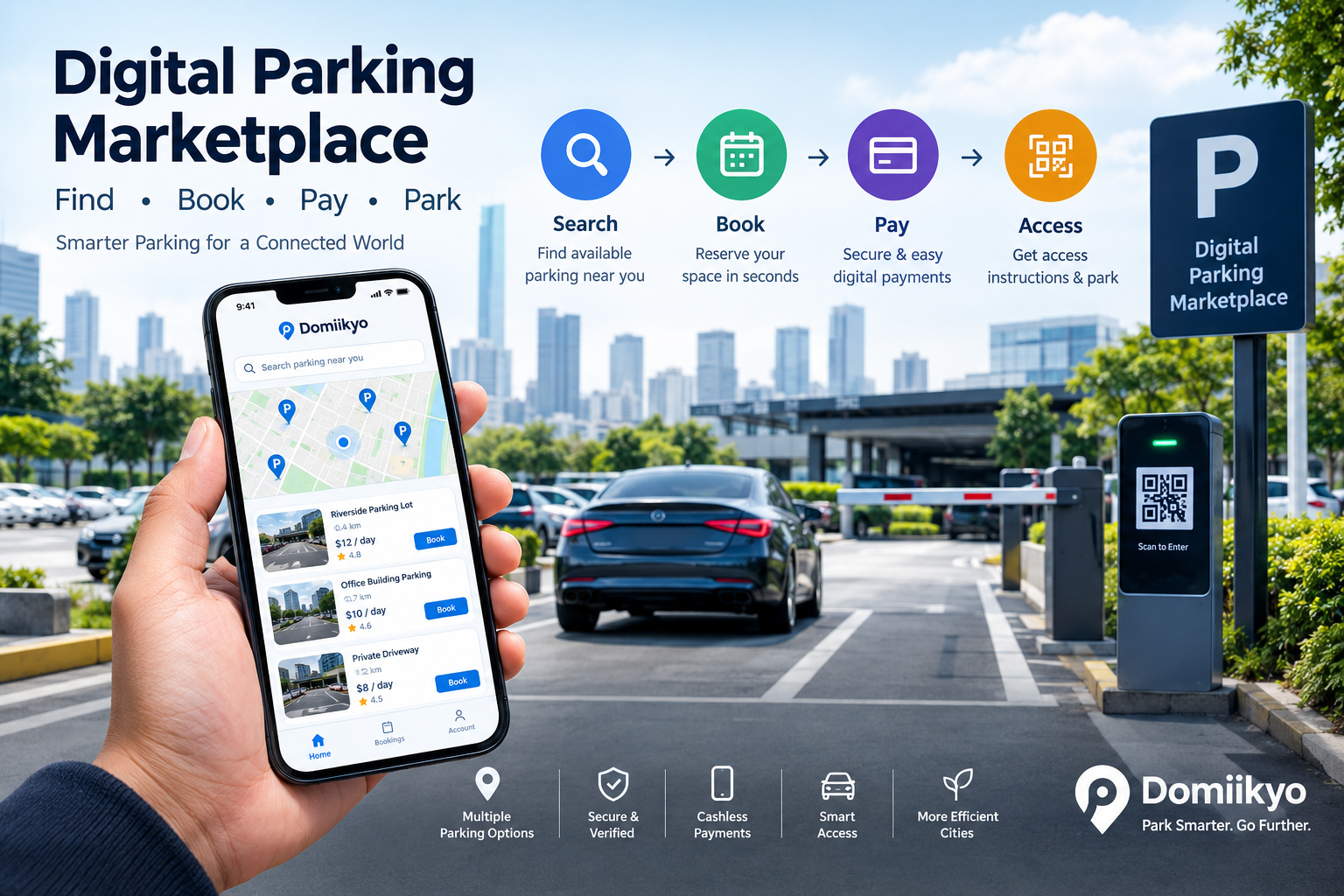
Digital Parking Marketplace: How It Works
Introduction
A digital parking marketplace is an online platform that connects drivers looking for parking with parking owners or operators who have available spaces. Users can discover parking, compare options, reserve a space, make payments, and receive access instructions through a website or mobile app.
Unlike traditional parking facilities, a marketplace can bring together parking inventory from multiple owners or operators rather than relying on a single parking property. This makes it possible to turn unused driveways, garages, commercial spaces, lots, and other parking capacity into bookable inventory.
But how does a digital parking marketplace actually work, and what technology makes the process possible? Let’s take a closer look.
What Is a Digital Parking Marketplace?
A digital parking marketplace is a technology platform that brings parking supply and parking demand together.
On one side are drivers who need convenient parking. On the other are property owners, businesses, parking operators, or other providers with available spaces.
The marketplace provides the digital infrastructure needed to connect both sides. Depending on the platform, this can include:
- Parking search and maps
- Real-time availability
- Space listings
- Price comparison
- Online reservations
- Digital payments
- Access instructions
- QR codes or digital passes
- Identity or vehicle verification
- Reviews and ratings
- Owner dashboards
- Booking management
The basic model is simple:
Parking owners provide supply → the marketplace connects them with drivers → drivers reserve and pay → the platform facilitates the transaction.
This is different from a traditional parking operator that owns or directly leases and manages the physical parking asset. A marketplace can instead activate parking capacity that already exists.
How Does a Digital Parking Marketplace Work?
Although platforms differ, the typical customer journey follows several steps.
1. A Parking Space Is Listed
A parking owner or operator creates a listing.
The listing can include:
- Exact location
- Photos
- Price
- Available hours
- Parking duration
- Vehicle restrictions
- Access instructions
- Amenities
- Cancellation rules
Some platforms allow owners to control their own prices and availability.
2. Drivers Search for Parking
The driver enters a destination or location and searches for available parking.
A useful parking marketplace should provide precise location information because parking decisions are highly dependent on distance and timing.
Map-based search can show:
- Available spaces
- Distance to destination
- Price
- Availability
- Parking type
- Walking distance
- Access information
3. Drivers Compare Available Spaces
Instead of driving around looking for an open space, users can compare available options digitally.
They may evaluate:
- Price
- Location
- Distance
- Availability
- Security
- Access method
- Reviews
- Vehicle suitability
This comparison step is one of the major advantages of a marketplace model.
4. The Driver Reserves a Space
Once the driver selects a suitable space, they can reserve it.
Some marketplaces offer instant booking, while others may require confirmation depending on how the parking provider operates.
Real-time availability and instant booking can be especially useful when drivers are searching shortly before arrival.
5. Payment Is Completed Digitally
The platform processes the parking payment.
A marketplace may collect:
- Parking price
- Service fee
- Booking fee
- Taxes where applicable
The platform can then distribute the appropriate amount to the parking provider while retaining its marketplace fee.
Marketplace infrastructure commonly supports payment collection, provider payouts, and transaction management.
6. The Driver Receives Access Information
After booking, the driver may receive:
- A confirmation
- QR code
- Digital parking pass
- Gate instructions
- PIN
- Smart-lock information
- License-plate-based access instructions
Modern parking platforms increasingly combine digital reservations with digital access control.
7. The Parking Session Is Completed
After parking, the transaction can be completed through the platform.
Depending on the service, the driver may leave a review while the platform records the transaction and processes the provider’s payout.
Who Uses a Digital Parking Marketplace?
A digital parking marketplace can serve several groups.
Drivers
Drivers use marketplaces to:
- Find parking
- Compare prices
- Reserve spaces
- Pay digitally
- Reduce parking-search time
- Access reserved spaces
Private Parking Owners
A homeowner or private owner may have a driveway, garage, or parking space that is unused for part of the day.
A marketplace can turn that unused capacity into potential income.
Businesses
Businesses may have parking spaces that are unused during certain periods.
For example, an office might have available spaces after business hours, while a restaurant may have different demand patterns during the day.
Parking Operators
Professional operators can use digital marketplaces to expose their inventory to additional drivers and generate advance reservations.
Way, for example, positions its marketplace specifically around parking operators and promotes advance reservations, inventory management, and access to its driver network.
Property and Housing Managers
Residential buildings and housing associations can also use digital systems for guest parking, shared parking, reservations, and access control. NaboSpot is one example of a platform combining parking sharing with digital access management.
What Types of Parking Can Be Listed?
A digital marketplace can potentially support many forms of parking inventory.
Examples include:
- Private driveways
- Garages
- Residential parking
- Commercial parking lots
- Office parking
- Airport parking
- Event parking
- Stadium parking
- Hospital parking
- University parking
- Monthly parking
- Long-term parking
- EV parking spaces
The exact inventory depends on the marketplace’s geographic coverage and business model.
Digital Parking Marketplace vs. Traditional Parking
| Digital Parking Marketplace | Traditional Parking |
|---|---|
| Multiple providers can participate | Usually one operator |
| Online search | Often physical search |
| Digital reservations | May rely on walk-ins |
| Online payment | Cash/card at facility |
| Multiple parking options | Limited inventory |
| Reviews and ratings may be available | Usually limited |
| Digital access may be supported | Physical ticket/access |
| Dynamic availability | Often less visible before arrival |
The key difference is that the marketplace adds a digital layer for discovering and transacting parking inventory.
Digital Parking Marketplace vs. Parking Aggregator
These terms can sound similar, but they are not necessarily the same.
Parking Aggregator
An aggregator primarily brings information from multiple sources together so users can discover available parking.
Parking Marketplace
A marketplace generally goes further by facilitating transactions between providers and customers.
The marketplace may manage:
- Listings
- Booking
- Payment
- Provider payouts
- Messaging
- Reviews
- Disputes
- Access
This transaction layer is an important distinction between simply displaying parking information and operating a marketplace.
Digital Parking Marketplace vs. Parking Management System
A parking management system primarily helps an operator manage parking operations.
A digital parking marketplace primarily connects parking supply with customers.
However, modern platforms can combine both.
| Marketplace | Parking Management System |
|---|---|
| Connects supply and demand | Manages parking operations |
| Driver discovery | Operator management |
| Reservations | Inventory management |
| Marketplace payments | Payments and enforcement |
| Multiple providers possible | Often focused on one organization |
| Customer acquisition | Operational efficiency |
Some modern platforms combine marketplace functionality, parking management, access control, payments, and other services into one ecosystem.
Key Features of a Digital Parking Marketplace
A successful platform needs more than a simple map.
Real-Time Parking Availability
Drivers need reliable information about whether a space is actually available.
Incorrect availability can quickly damage user trust.
Map-Based Search
Location is one of the most important factors in parking.
Users should be able to search by destination, map location, address, or nearby landmark.
Online Reservations
Reservations give drivers greater certainty before they arrive.
Digital Payments
Users should be able to complete transactions without depending on cash.
Identity Verification
Verification can help establish trust between parking providers and drivers.
Vehicle Verification
Some platforms may collect vehicle information to help identify authorized vehicles.
Reviews and Ratings
Reviews can help drivers evaluate spaces and give providers feedback about customer behavior.
Digital Access
Depending on the parking location, access may involve:
- QR codes
- PINs
- Smart locks
- Mobile credentials
- License plate recognition
- Digital permits
Provider Dashboard
Parking owners and operators may need tools for:
- Managing listings
- Setting prices
- Updating availability
- Viewing bookings
- Tracking revenue
- Managing customers
Key Features of a Digital Parking Parking Marketplace
The marketplace itself needs a sustainable revenue model.
Commission Fees
The platform can take a percentage of each booking.
For example:
Driver payment → marketplace fee → provider payout
Commission-based monetization is a common marketplace model.
Booking Fees
Some platforms can charge a separate service or booking fee.
Subscriptions
A marketplace may offer recurring parking plans for commuters or customers who regularly need the same location.
Premium Listings
Providers could potentially pay for enhanced visibility or promotional placement.
Business Partnerships
Parking platforms can also develop relationships with:
- Employers
- Hotels
- Airports
- Stadiums
- Universities
- Property managers
- Mobility companies
The right revenue model depends on the marketplace’s audience, geography, supply, and operating costs.
Benefits of Digital Parking Marketplaces
Benefits for Drivers
Drivers can potentially:
- Find parking faster
- Reserve before arrival
- Compare options
- Pay digitally
- Receive access instructions
- Reduce uncertainty
Benefits for Parking Owners
Owners can:
- Monetize unused parking
- Control availability
- Set prices
- Receive bookings
- Reach new customers
Platforms such as Parkr and Parkanize explicitly position unused private parking as an opportunity for recurring income.
Benefits for Parking Operators
Operators can use marketplaces to:
- Increase digital visibility
- Generate advance bookings
- Improve occupancy
- Manage inventory
- Reach new customers
Way, for example, markets advance reservations and inventory/rate control to parking operators.
Benefits for Cities
At a broader level, digital parking technology can contribute to more connected parking and mobility systems when parking data, payments, access, and management systems work together.
Are Digital Parking Marketplaces Safe?
Safety depends on the platform, parking provider, technology, and local policies.
A trustworthy marketplace should clearly explain:
- Who provides the parking space
- What is included
- Where the space is located
- How payment works
- How access works
- Cancellation rules
- Refund policies
- Dispute procedures
- Privacy practices
Verification can also play an important role.
Some newer marketplace platforms use location verification, identity verification, access codes, reputation systems, or other controls designed to reduce fraudulent listings and unauthorized use.
Drivers should still verify the parking location, instructions, restrictions, and terms before completing a booking.
What Technology Powers a Digital Parking Marketplace?
The technology behind these platforms can be extensive.
GPS and Mapping
Mapping technology helps users locate parking spaces and estimate their distance from a destination.
Cloud Platforms
Cloud infrastructure allows listings, bookings, accounts, and transactions to be managed at scale.
Payment Processing
Payment systems handle customer charges and provider payouts.
Parking Sensors
Sensors can provide information about occupancy and availability.
License Plate Recognition
LPR technology can help identify vehicles and automate entry or exit in compatible facilities.
QR Codes
QR codes can provide digital access or payment workflows.
Smart Locks and Barriers
Connected access devices can allow authorized drivers to enter without requiring a physical key handoff.
APIs
APIs allow parking marketplaces to integrate with:
- Maps
- Payments
- Access systems
- Parking management software
- Mobility platforms
- Third-party applications
Data Analytics
Analytics can help operators understand:
- Occupancy
- Demand
- Booking patterns
- Revenue
- Peak periods
- Customer behavior
This technology layer is increasingly turning parking platforms into broader digital parking ecosystems rather than simple reservation websites.
Examples of Digital Parking Marketplaces
The market includes different types of platforms.
Way
Way focuses heavily on connecting parking operators with drivers and emphasizes advance reservations, inventory management, and demand generation.
Parkr
Parkr describes itself as a peer-to-peer private parking marketplace where users can find spaces and owners can monetize driveways.
Parkanize
Parkanize connects parking-space owners with renters and supports different rental durations, pricing, availability, booking, and digital access.
NaboSpot
NaboSpot combines parking sharing with access management for drivers, hosts, and housing associations.
These examples demonstrate that the digital parking marketplace category can include both peer-to-peer parking and professional parking-operator inventory.
Challenges of Digital Parking Marketplaces
The concept sounds straightforward, but building a reliable marketplace presents several challenges.
Supply and Demand
Drivers will not use a marketplace if there are no useful spaces nearby.
Owners may not list spaces if there are not enough potential customers.
This creates the classic marketplace chicken-and-egg problem.
A geographically focused launch can help build enough supply and demand in one area before expanding.
Accurate Listings
Incorrect photos, addresses, availability, or instructions can lead to failed parking sessions.
Trust
Both sides need confidence that the transaction will work.
Access Problems
A driver may arrive and discover:
- A blocked space
- Incorrect instructions
- A broken gate
- An invalid access code
The platform needs a clear support and dispute process.
Local Regulations
Parking rules vary by location.
Before renting private or commercial spaces, providers should understand relevant local regulations, permits, property restrictions, and insurance requirements.
Competition
Large parking platforms can have strong brand awareness, existing supply, and established customer bases.
A smaller marketplace often needs a clear geographic or audience niche to compete.
The Future of Digital Parking Marketplaces
Digital parking marketplaces are likely to become increasingly connected with broader mobility technology.
Future developments may include:
- AI-assisted parking search
- Predictive parking availability
- Dynamic pricing
- Connected vehicles
- Automated payments
- License plate recognition
- Smart parking sensors
- EV charging integration
- Digital access credentials
- Smart-city platforms
- Mobility-as-a-service integrations
The direction is already visible in platforms that combine parking marketplaces with access management, digital payments, analytics, and broader mobility services.
The long-term opportunity is not simply to help someone find a parking space.
It is to create a connected digital system where parking can be:
discovered → compared → reserved → paid for → accessed → monitored → managed digitally.
Final Thoughts
A digital parking marketplace connects parking supply with people who need parking through an online platform.
For drivers, it can make parking easier to discover, compare, reserve, and pay for. For parking owners and operators, it can provide a way to expose available inventory to new customers and potentially increase utilization.
The most advanced platforms go beyond reservations. They combine maps, real-time availability, payments, verification, digital access, analytics, and parking management into a connected experience.
As cities become more digitally connected and parking demand becomes increasingly data-driven, digital parking marketplaces have the potential to become an important part of the broader smart-mobility ecosystem.
Frequently Asked Questions
1. What is a digital parking marketplace?
A digital parking marketplace is an online platform that connects drivers looking for parking with parking owners or operators offering available spaces. It can support discovery, comparison, reservations, payments, and digital access.
2. How does a digital parking marketplace work?
Drivers search for available spaces, compare options, select a location, reserve it, pay through the platform, and receive instructions for accessing the parking space.
3. How do parking marketplaces make money?
Most marketplace models can generate revenue through commissions or service fees on bookings. Other potential revenue sources include subscriptions, premium listings, and business partnerships.
4. Can I rent out my private parking space online?
Yes, where local laws and property rules permit it. Some peer-to-peer parking marketplaces allow owners to list driveways, garages, and private spaces for short- or long-term use.
5. Are digital parking marketplaces safe?
They can be, but users should check provider information, reviews, payment security, access instructions, cancellation policies, and dispute procedures before booking.
6. What features should a parking marketplace have?
Important features include map search, accurate availability, reservations, digital payments, provider dashboards, reviews, verification, access instructions, and customer support.
7. What is the difference between a parking marketplace and an aggregator?
An aggregator primarily combines parking information from multiple sources. A marketplace typically goes further by enabling transactions between parking providers and customers.
8. What technology is used by digital parking marketplaces?
Common technologies include GPS, mapping, cloud platforms, payment processing, APIs, parking sensors, QR codes, license plate recognition, smart locks, access control, and analytics.
9. Can businesses list unused parking spaces?
Yes. Depending on the platform and local rules, businesses can potentially make unused parking capacity available during periods when those spaces are not needed.
10. What is the future of digital parking marketplaces?
The sector is moving toward more connected systems involving AI, predictive availability, dynamic pricing, digital access, EV charging, smart parking sensors, automated payments, and broader smart-mobility platforms.